


How Warm Water Environments Help Babies Relax and Learn

Have you ever held your baby in a cool pool and watched them tense up, stiffen their limbs, or cry?
Have you already witnessed the powerful link between water temperature and a baby's comfort?
Did you notice that the opposite is equally true?
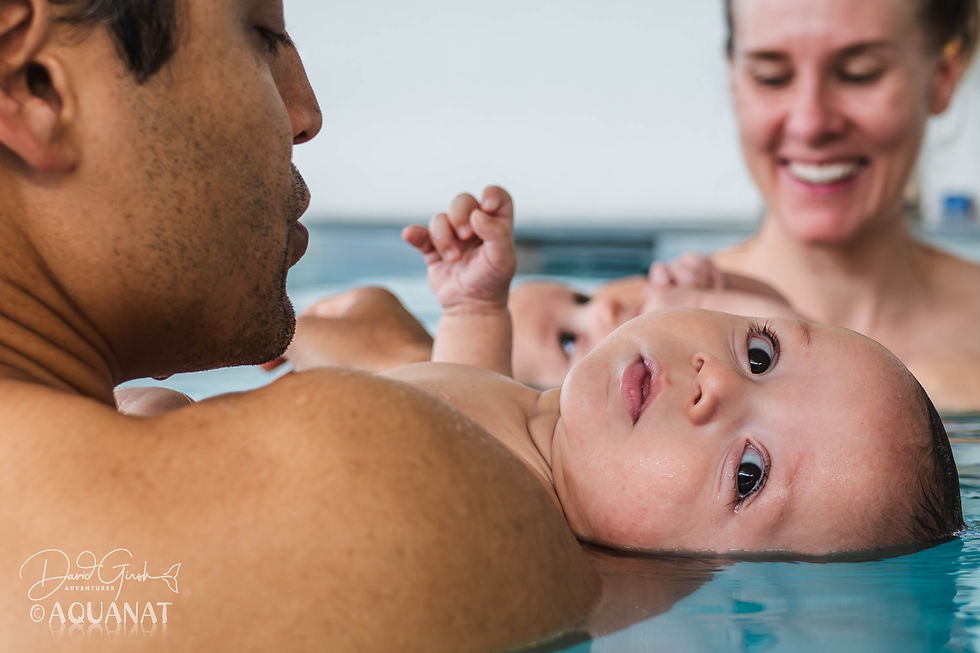
In warm water, babies visibly soften. Their breathing slows, their bodies open up, they are happy to engage and become far more receptive to new experiences.
That is not a coincidence.
At Aquanat, the pool is intentionally maintained at 34–35°C, a temperature carefully chosen to create the same comfort babies experience in the womb.
But warm water is only the beginning; what it makes possible in a baby's brain and body is where the real story starts.
Why Water Temperature Matters for Babies
Babies are far more sensitive to their thermal environment than adults, and the reasons are physiological. Their higher surface area relative to body mass means they lose and absorb heat rapidly through the skin. Their hypothalamus — the brain's internal thermostat is still developing, so unlike adults, they cannot shiver to warm up or sweat to cool down. They also have a limited reserve of brown fat around the neck and shoulders that generates heat without shivering, but this is a modest and temporary resource. Most fundamentally, a baby enters the world calibrated to the womb's consistent warmth of around 37°C. Any meaningful drop from that baseline doesn't register as mild discomfort; it registers as a stressor on the nervous system.
This is why the reaction to cool water is so immediate and so visible. The thermoreceptors in a baby's skin are densely distributed and highly sensitive, sending signals to the nervous system before any conscious processing occurs. The result is the stiffening, crying, and withdrawal parents often witness at the pool's edge, not a behavioural choice, but a physiological response to perceived threat.
Warm water removes this layer of stress entirely. When the thermal environment is right, the body does not spend energy trying to maintain comfort, and that changes everything about how a baby experiences and is able to learn from what follows.
How Warm Water Helps Babies Feel Relaxed
The relationship between warmth and relaxation is deeply physiological. Warm water causes the blood vessels near the skin's surface to dilate, which improves circulation and creates a gentle, whole-body sense of ease. Muscles that might otherwise hold tension begin to release. The nervous system, no longer responding to thermal discomfort, can settle into a calmer state.
For babies, this matters enormously. A relaxed baby is a baby who is present and open. They are more likely to make eye contact, respond to their parent or instructor, move freely in the water, and engage with new experiences rather than retreat from them. In warm water, you often see babies who arrived anxious or fussy begin to visibly unwind within minutes, and that shift is not just emotional. It is biological.
This is why warm water baby swimming is not simply about making classes more pleasant. It is about creating the physiological conditions under which real learning can take place.
The Connection Between Relaxation and Early Learning
Learning, at any age, requires a certain state of readiness. For that state to exist, a person needs to feel safe, calm, and not overwhelmed. This is as true for a six-month-old in a pool as it is for anyone else.
When babies are stressed, whether from cold water, loud environments, unfamiliar faces, or overwhelming sensory input, their nervous systems prioritise survival responses over learning ones. They cry, they withdraw, they cling. They are not in a state where new experiences can be absorbed and processed in a positive way.
Warm water creates the opposite conditions. A baby who is physically comfortable and emotionally at ease is far more receptive to sensory input, movement, and the gentle guidance of a trusted adult. This is when early water skills, breath control, buoyancy, and body position begin to be laid down, not just as an intentional pedagogical lesson, but as lived, felt experiences that the body remembers.
The developmental benefits of swimming lessons that begin in warm, calm conditions go far beyond the pool. The patterns of trust, relaxation, and curiosity that babies develop in these early environments carry into how they approach learning more broadly.
How Warm Water Supports Water Confidence in Babies
Water confidence is not something you can rush or manufacture. It grows slowly from the inside out, as a baby accumulates positive experiences in the water and begins to associate the aquatic environment with safety, warmth, and connection.
Warm water swimming for babies provides the ideal conditions for this process. When babies feel comfortable from the moment they enter the pool, every subsequent experience, being gently moved through the water, supported on their back, watching bubbles, moving their arms and legs, is encouraged and received from a place of joy and calm rather than industriousness. These experiences stack up over time and build the foundations for genuine water confidence.
On the other hand, babies who experience repeated discomfort or distress in the pool, often because of cold water, noise, or large, unfamiliar environments, can develop an association between water and stress that becomes harder to undo. Early-age swimming lessons that prioritise warmth and comfort protect against this outcome from the very beginning. If your older child is already struggling with this, our guide on 10 Tips to Help Kids Overcome Fear of Water may be helpful.
The Importance of Calm and Supportive Swim Environments
Water temperature is one piece of the puzzle, but it works best together with a broader environment designed with babies' needs in mind.
At Aquanat, every element of our swim school is intentionally chosen. Our pool in Alfred Cove is small, quiet, and free from the noise and chaos that often characterise larger aquatic centres. We keep class sizes to a maximum of six, so that each baby receives genuine individual attention, and so that the atmosphere in and around the pool stays calm, unhurried, and low stimulus.
For babies whose sensory systems are still developing rapidly, these details are not minor. A loud, crowded environment can overwhelm a baby just as much as cold water can, even if the temperature is right. True comfort requires the whole environment to work together, and that is exactly what child-focused swimming lessons should deliver.
And what about the parents?
Most parents step into our pool and say the same thing: they didn't expect to enjoy it quite so much themselves.
When parents are comfortable, their babies feel it. Babies are exquisitely attuned to the emotional state of the adults holding them, and parental anxiety transfers through touch, voice, and body language faster than any verbal reassurance can counter it.
The reverse is equally true.
Warm water swim classes benefit parents just as much as babies. When you step into a warm, welcoming pool and feel your baby relax in your arms, when you can see and feel that they are content, your own confidence as a caregiver in the water grows. You relax your grip. Your shoulders drop. You begin to enjoy the experience rather than simply manage it.
This is one of the most meaningful outcomes of warm water baby swimming: the gradual, genuine growth of confidence in both parent and child, together. When parents feel at ease, they communicate safety. When babies feel that safety, they open up to everything the lesson has to offer.
Choosing the Right Swimming Environment for Babies
Not all swim schools are created equal, and when it comes to babies, the details of the environment matter enormously. When choosing where to begin your baby's swimming journey, there are several things worth considering.
Pool temperature is the obvious starting point. Pools maintained below around 32°C are simply too cool for young babies and toddlers and will undermine comfort and learning regardless of how skilled the instructor is. Warm water, ideally 34–35°C, is a non-negotiable foundation for effective baby and toddler swimming classes.
Beyond temperature, look for small class sizes that allow for individual attention and a calm atmosphere. Consider the noise level and overall sensory environment. Ask about the philosophy of the school. Does it prioritise rigid structure and progression, or does it genuinely put the child's emotional experience first? And consider whether the instructors understand infant development, not just swimming technique.
At Aquanat, every one of these considerations shaped how we designed our environment and built our programme from the beginning. We work with babies during one of the most significant windows in human development: the first two years of life, when the brain is forming new neural pathways at a rate it will never again match. That is not something we take lightly. It is why the water temperature, the class size, the noise level, the pace of every lesson, and the training of every instructor are all held to the same standard.
Long-Term Benefits of Positive Early Swimming Experiences
The time you invest in early-age swimming lessons does not just teach your baby to be comfortable in the water now. It sets in motion a relationship with water that can last a lifetime.
Babies who experience warm, calm, supportive swim environments in their earliest months and years develop a deep-seated comfort with water that forms a foundation for learning to swim later on. They approach the pool with ease rather than resistance. They trust the water rather than fear it. And because they associate swimming with positive experiences intertwined with warmth, closeness, play, and connection, they are far more likely to remain engaged and motivated as they grow.
The developmental benefits of swimming lessons that begin well go beyond water skills. Research consistently links regular swimming in early childhood to improved gross motor development, enhanced spatial awareness, and better physical coordination.
Frequently Asked Questions
Why is warm water important for baby swimming lessons?
Warm water is important because babies cannot regulate their own body temperature effectively, and cool water triggers a physiological stress response that causes muscle tension, discomfort, and emotional distress. In warm water, ideally around 34–35°C, babies can relax fully, which creates the conditions necessary for positive sensory experiences, early learning, and the development of genuine water confidence. Warm water is not simply a comfort measure; it is a foundational requirement for effective baby swimming.
What is the ideal pool temperature for babies?
For very young babies, the ideal pool temperature sits between 34°C and 35°C, warm enough to prevent rapid heat loss and mirror the thermal environment of the womb, without becoming uncomfortably hot. At Aquanat, our pool was purpose-built with precise temperature control, which allows us to adjust the water to suit the age and needs of each group. Toddler classes may run at 33–34°C, while classes for very young babies are warmed to 35°C. This level of flexibility is something large pools simply cannot offer, and it makes a meaningful difference to how settled, comfortable, and ready to learn babies are from the moment they enter the water.
Does warm water help babies feel more comfortable while swimming?
Yes — significantly so. Warm water has a direct physiological effect on the body: it causes muscles to relax, blood vessels to dilate, and the nervous system to settle into a calmer state. For babies, who are particularly sensitive to their environment, this translates to visibly less tension, less crying, and much greater openness to new experiences. Many families tell us that they see their baby transform within the first few minutes in our warm pool.
Can warm water baby swimming improve confidence in water?
Warm water baby swimming creates the conditions under which water confidence can naturally develop. When babies consistently experience the pool as a warm, comfortable, and safe environment, they begin to associate water with positive feelings rather than stress or discomfort. Over time, this positive association becomes the foundation for genuine confidence — the kind that allows a child to approach the water with ease, curiosity, and willingness to try new things.
How do warm swimming environments support baby development?
Warm swimming environments support baby development in several interconnected ways. Physically, warm water allows babies to move freely, which supports gross motor skills, body awareness, and coordination. Neurologically, the sensory richness of warm water — its pressure, movement, sound, and temperature — provides valuable input that contributes to sensory integration. Emotionally, the experience of being held and guided in a safe, warm environment supports attachment and builds the trust that underpins all early learning. Together, these effects make warm-water swimming one of the most holistic and beneficial activities available to very young children.
early-age swimming lessons


